
Stark County Court Records After Arrest
The Stark County pathway is local and fairly direct. A person arrested in Toulon, Wyoming, Bradford, LaFayette, or rural Stark County is booked through the Stark County Sheriff's Office when the person is held at Stark County Jail. That booking record is a sheriff's record. It may list the arresting agency, intake time, booking charge, release status, and related jail data. The court record begins when the State's Attorney reviews the police reports and files or pursues charges in court.
That distinction matters because a booking charge is not always the final court charge. The Stark County State's Attorney can amend, reduce, dismiss, add, or replace counts after reviewing the facts. The formal case is then maintained by the Stark County Circuit Clerk and is searched through Judici when public access is available. Jail custody and booking details belong with Stark County jail inmate records, while booking photos are handled through the Stark County jail mugshots records process.
Find Stark County Court Records
The Stark County Circuit Clerk is the court recordkeeper for cases moving through the local court system. The office lists criminal, civil, traffic, ordinance, conservation, and probate records. Stark County is part of the Tenth Judicial Circuit, and the clerk's page points public users to Judici for online case access where Stark County participates.
Judici lists public categories such as litigant information, criminal charges, dispositions and sentences, civil judgments, fines and fees, hearing dates, case minutes, wills indexes, and documents. Basic public search is separate from subscriber services. A CAPTCHA may appear, so automated or repeated search attempts can fail even when public access exists. If a case is older, impounded, unclear, or missing from an online search, the clerk counter or phone line is the official next step.
The Judici public access portal is the online court-search channel identified for Stark County court records after a jail arrest.
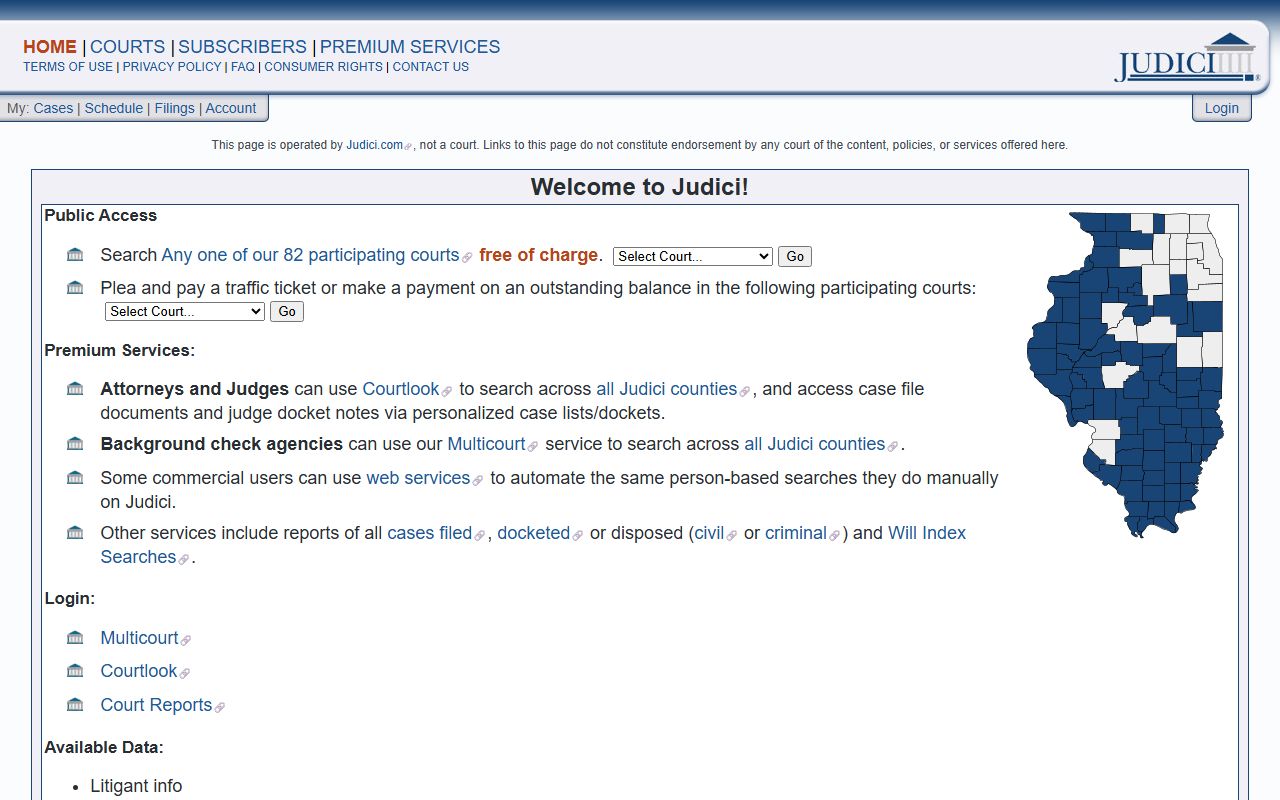
The portal context is important because court records show filed charges and case events, not the same thing as the jail booking record.
| Judici item | Type | Required | Stark County note |
|---|---|---|---|
| Participating court | County/court selection | Yes | Stark County, IL is listed as a participating court. |
| Name or case number | Search value | Usually | Use the defendant's legal name or a known case number. |
| Payment functions | Dropdown/link | Conditional | Stark appears for payment tools, but payments do not confirm custody. |
| CAPTCHA | Challenge | May appear | Direct search access can be limited by anti-automation checks. |
Search After a Stark Arrest
A recent arrest can take time to move from jail intake to a court docket. If the arrest is very new, confirm custody with the sheriff first. Once a court case exists, read the court case record instead of relying only on a jail booking label. Court rows can show the charge filed, the hearing schedule, the case status, and the eventual disposition.
- Call the Stark County Sheriff's Office at (309) 286-2541 if the arrest just happened or custody status is the first question.
- Search Judici for Stark County by defendant name or case number once a case may have been opened.
- Open the criminal case record and compare the formal charge list with any booking charge you were given.
- Review hearing dates, minutes, dispositions, fines, fees, and sentence rows before assuming a charge led to conviction.
- Contact the Circuit Clerk at (309) 286-5941 for older files, access problems, or case records that are not clear online.
The Circuit Clerk's office is at PO Box 426, 130 West Main St., Toulon, IL 61483. Its published phone is (309) 286-5941, fax is (309) 286-4039, and email is circuitclerk@starkco.illinois.gov. Hours are Monday through Friday, 8:30am to 4:30pm. The clerk can provide court records and filing information, but the office cannot give legal advice.
Stark Arrest Charging Documents
The first jail entry does not decide the final court case. After a Stark County arrest, law enforcement creates reports and booking records. The State's Attorney then decides what charge document to file or pursue. Illinois cases can use a complaint, information, or indictment depending on the charge, stage, and court process. Each one is a court record, not a jail roster record.
| Document | Who starts it | Common use | What to check |
|---|---|---|---|
| Complaint | Law enforcement or prosecutor | Often starts criminal or traffic-related cases | Charge wording, date, count, and first court date. |
| Information | State's Attorney | Many filed criminal prosecutions | Formal count, class, amended language, and disposition. |
| Indictment | Grand jury | More serious felony practice | Grand-jury charge, count numbers, and later plea or trial result. |
Austin King is listed as Stark County State's Attorney, with Lori Watson listed as assistant. The office is at 130 W Main St, PO Box 476, Toulon, IL 61483-0476. Published hours are Monday through Friday, 8:30am to 4:30pm. The prosecutor files and pursues charges, but the prosecutor is not the Circuit Clerk, the jail, or defense counsel.
Stark Court Charge Status
Charge status is the short label that tells where a count stands. It should be read with the court minutes and disposition, not in isolation. A person can be arrested and released before the case is filed. A charge can be filed and later amended. A dismissed count does not mean every other count is gone. A sentence row may apply to only one count in a multi-count case.
| Status | Plain meaning | Stark County lookup tip |
|---|---|---|
| Pending | The charge or case has not reached a final outcome. | Check the next hearing date and recent case minutes. |
| Amended | The prosecutor changed the charge wording or count. | Compare old and new counts before quoting the case. |
| Reduced | A lesser charge replaced a more serious count. | Look for plea, dismissal, or amended-count entries. |
| Dismissed | The count ended without a conviction on that count. | Check whether other counts remain pending or were resolved. |
| Nolle prosequi | The prosecutor declined to proceed on a charge. | Read the whole docket for related counts or refiling issues. |
| Disposition | The court outcome for a count. | Disposition is the key row for conviction, dismissal, or sentence. |
First Appearance and Release
Illinois changed pretrial release practice through the Pretrial Fairness Act. For new cases, cash bail was eliminated and the judge decides release conditions or detention under Illinois pretrial statutes. In a Stark County case, the first appearance is the court point where rights, probable cause, charging status, and release or detention can become part of the record. Older obligations or older case balances may still differ, so payment questions should be confirmed with the clerk or jail.
Release note: A warrant, bench warrant, IDOC sentence, federal hold, immigration hold, or another agency's detainer can prevent release even when the local charge looks minor.
725 ILCS 5/109-1 addresses initial appearance after arrest. 725 ILCS 5/110-5 covers pretrial release and detention factors. Those statutes are statewide rules, so local docket entries should be read with the actual Stark County court order.
Stark Warrants and Arrest Records
No official Stark County Sheriff's Office active warrant search, warrant list, or most-wanted page was located in the county sources reviewed. That means a warrant check should not start with an unofficial aggregator. For local warrant questions, use the sheriff phone line or in-person office, then use the Circuit Clerk or Judici for bench-warrant context tied to an existing court case.
An arrest warrant authorizes an arrest for a charge. A bench warrant is issued by a judge, often after failure to appear or violation of a court order. A search warrant is different because it authorizes a search and may be sealed or restricted. If another county, another state, federal court, or immigration authority is involved, the Stark County Jail may only be a temporary hold point.
Charges Versus Convictions
A court charge is an accusation filed in a case. A conviction is a finding or admission of guilt through plea, verdict, or other qualifying disposition. The difference is central to reading Stark County court records after a jail arrest because a booking record, a pending charge, and a conviction all carry different meanings.
| Point of comparison | Charge | Conviction |
|---|---|---|
| Stage | Filed or pursued after arrest and review. | Entered after plea, verdict, or qualifying disposition. |
| Meaning | An accusation that must still be proved or resolved. | A court outcome that can support sentence or supervision. |
| Proof level | Based on probable cause and filed allegations. | Requires plea or proof beyond a reasonable doubt. |
| Record reading | Check status and next hearing. | Check sentence, fines, custody credit, and discharge status. |
Sealed and Expunged Records
Some Stark County court records after an arrest are public, but not all case files stay public in the same way. Adoption, juvenile, mental-health, and impounded files are not public through ordinary clerk access. Other criminal records may become restricted through sealing or expungement if the person qualifies under Illinois law. The Criminal Identification Act provides the statewide framework, but eligibility depends on the charge, result, timing, and criminal history.
| Point of comparison | Sealed | Expunged |
|---|---|---|
| Public view | Hidden from most public searches. | Removed or treated as cleared under the court order. |
| Agency access | Some agencies may still have limited access. | Access is more restricted, subject to Illinois law. |
| Common trigger | Eligible case outcome after waiting rules are met. | Eligible arrest or case result, often non-conviction based. |
| Action needed | Usually requires a petition and court order. | Usually requires a petition and court order. |
Sealing or expungement is not automatic just because a person was released from Stark County Jail. The court order controls what the clerk and law enforcement must restrict. If a case is sealed, online portals may show less than the clerk can see internally.
Restricted Court Arrest Records
Illinois public access rules do not make every record open. FOIA covers public records held by public bodies, but court files also follow court rules and confidentiality laws. Juvenile files, mental-health matters, adoption files, impounded cases, sealed records, active investigative material, safety-sensitive records, and correctional-security material can be withheld or redacted.
The best route depends on the record type. Arrest reports and booking data start with the sheriff or a FOIA request through the county clerk's FOIA officer. Formal criminal cases start with Judici and the Circuit Clerk. Prosecutor files are not a substitute for the court docket. Custody notifications may also be available through Illinois VINE, but VINE does not replace the official court record.
Important: Court and arrest data may not be used for credit, employment, housing, insurance, or any other FCRA-covered decision.